
📸 Understanding Traditional f-Stops — A Photographer’s Guide

When you first pick up a camera, you’ll hear about the mysterious f-stop numbers: f/1.4, f/2.8, f/8, f/16... but what do they really mean?
Let’s break it down in simple terms, with visuals.
🌟 What is an f-stop?
An f-stop (or f-number) is the ratio between your lens’s focal length and the aperture diameter (the opening that lets light through).
Small f-number (f/1.4, f/2) → wide opening, more light, shallow depth of field.
Large f-number (f/16, f/22) → narrow opening, less light, deep depth of field.
🔢 The Traditional Full-Stop Scale
The standard f-stop sequence follows powers of √2 (~1.414).
Each step means half as much light enters:
f/1.0 – f/1.4 – f/2 – f/2.8 – f/4 – f/5.6 – f/8 – f/11 – f/16 – f/22 – f/32
👁 Visualizing Aperture, Light & Depth of Field
Here’s an easy cheat sheet combining all three:
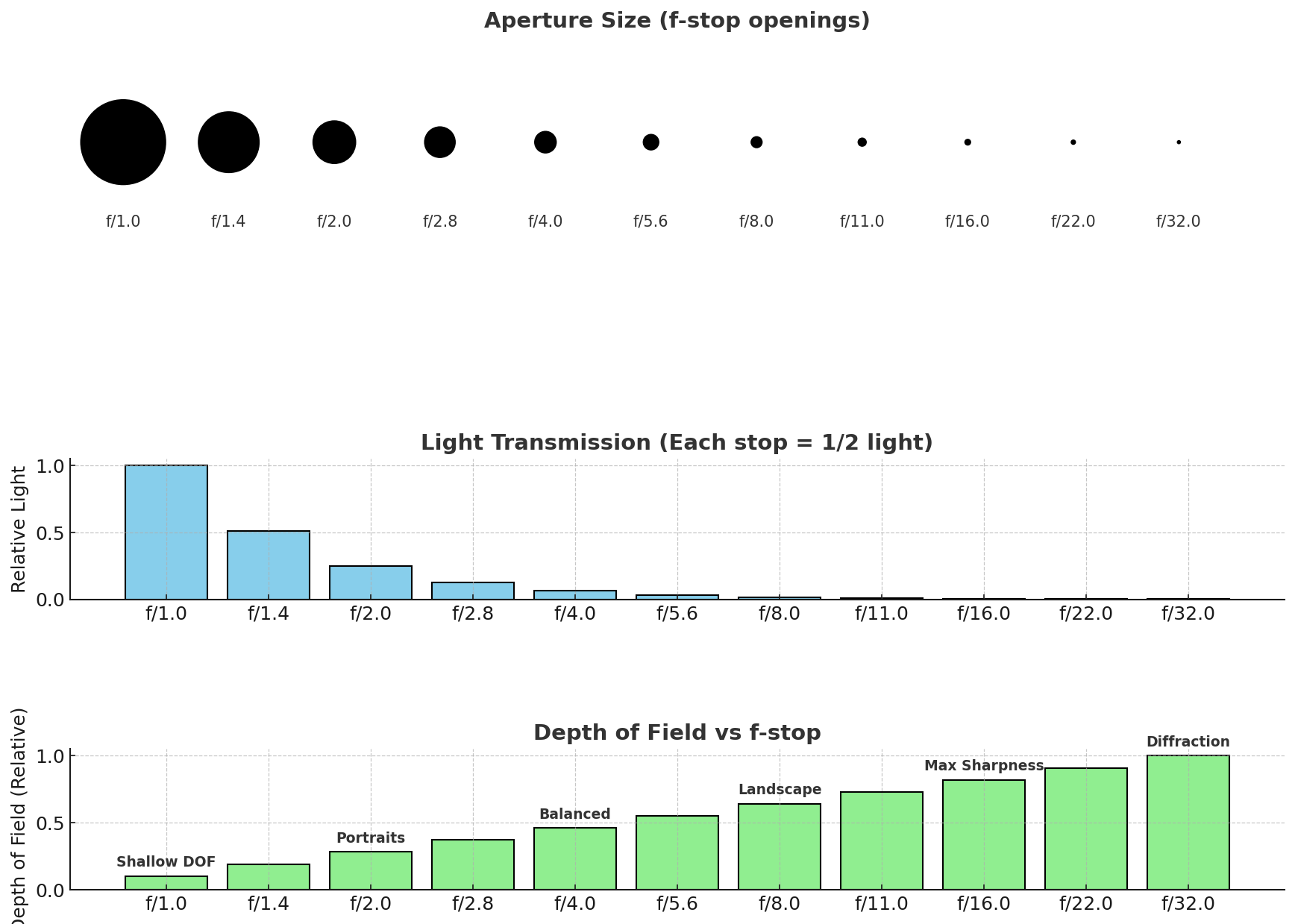
Top row: Aperture openings (how wide the lens is at each f-stop).
Middle bar: Relative light transmission (each stop halves the light).
Bottom bar: Depth of field (DOF) increases as f-stop goes up.
🎯 Depth of Field (DOF) in Practice
Wide aperture (f/1.4–f/2.8) → creamy background blur (bokeh), focus only on your subject.
Mid-range (f/5.6–f/8) → balanced sharpness, great for portraits or street photography.
Narrow aperture (f/11–f/22) → maximum sharpness front to back, perfect for landscapes.
📝 Quick Takeaways
f-stop = aperture size = controls light & depth of field.
Lower f-number = more light + shallower DOF.
Higher f-number = less light + deeper DOF.
The traditional scale doubles/halves light at each step.
👉 Next time you shoot, remember: f-stops are a balancing act between exposure and creative intent.